



In the wake of global disruptions—from pandemics to conflict—schools have found themselves grappling with a difficult question: how do you support students beyond academics when the world itself has changed?
For Mohammed Chehab, this wasn’t just a theoretical problem. It was something he had seen up close.
A three-time founder with two exits, Chehab’s journey into education wasn’t accidental. It was shaped by years of building across industries, working with global teams, and observing how systems respond, or fail to respond, to human challenges. But it was during his work across different educational ecosystems that something became clear: student experiences, especially after crises, were being treated as isolated issues rather than systemic ones.
“Students aren’t going through individual experiences,” he explains. “They’re going through shared, community-level disruptions.”
That realisation became the foundation for BuzzGage.
Moving Beyond “Support” to Systems
At its core, BuzzGage is not just another wellbeing initiative. It is an attempt to restructure how institutions understand and respond to student needs.
Rather than focusing solely on interventions like counselling or wellness programmes, BuzzGage introduces a more structured approach; one that translates student experiences into measurable insights for schools.
The idea is simple, but powerful: turn student voice into actionable, data-driven priorities.
This shift from reactive support to proactive system design is what sets BuzzGage apart.
Building in the Aftermath of Crisis
The idea for BuzzGage, originally conceptualised under what Chehab described as “Boardscape,” emerged during a period of widespread disruption.
Working with international teams from San Jose to Australia, his team began to observe a recurring pattern: institutions were struggling to make sense of what students were going through after crises.
There was no shared structure. No unified way to interpret student experiences at scale.
So they built one.
“We realised that what students were facing wasn’t just individual,” Chehab says. “The systems and environments around them shaped it.”
BuzzGage’s Post-Crisis Student Wellbeing Recovery Framework was designed to address exactly that gap by helping schools move from fragmented responses to coordinated recovery strategies.
The framework focuses on six non-clinical wellbeing dimensions: Sense of Safety and Predictability, Displacement and Disruption, Grief and Loss Processing, Exposure to Distressing Information, Hope and Agency, and Identity Threat and Stigma Sensitivity.
From Insight to Implementation
One of the biggest challenges in building something like BuzzGage is the adoption. Education systems are complex. Trust, credibility, and alignment with institutional priorities are critical. But so far, the startup’s approach has been rooted in collaboration.
Go deeper on GCC & Africa tech — $9.99/month.
Deep dives and investor insights the free digest doesn't cover.
By engaging with partners across global education ecosystems and participating in key conversations within the sector, BuzzGage has positioned itself not just as a product but as a thought partner.
“We’ve been working closely with partners who understand the importance of tackling these issues,” he says. “There’s a shared vision.”
That alignment has been key to early traction.
The Quiet Complexity of Student Wellbeing
While the conversation around student mental health has grown in recent years, Chehab believes the real challenge lies deeper in how institutions interpret and act on that data.
Wellbeing, in many cases, remains difficult to measure, standardise, and integrate into decision-making.
BuzzGage aims to change that by introducing structure without losing the human context behind the data.
It’s a delicate balance: building systems that are rigorous enough for institutions, yet sensitive enough for the students they serve.
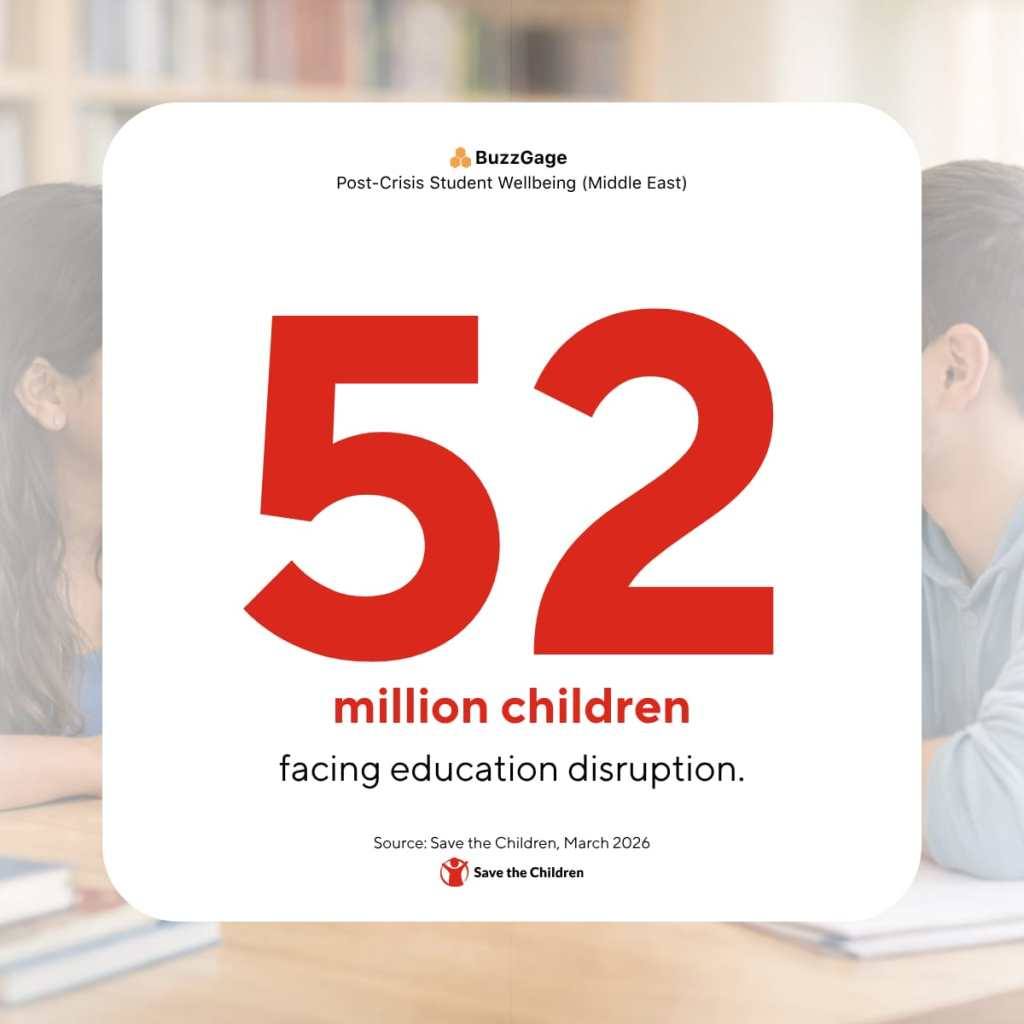
“In times of crisis, what students carry into the classroom is often unseen, yet it directly shapes how they learn, engage, and recover,” Chehab said at the launch of the framework. “This framework is designed to make that invisible layer visible, so schools and systems can respond with clarity, responsibility, and care at scale.” [Quote from official press release]
Looking Ahead
From all indications, the vision for BuzzGage goes beyond being a standalone product.
Chehab sees it evolving into something much bigger, an infrastructure layer for how education systems understand student wellbeing globally.
“This is an opportunity to share knowledge and build something that supports institutions at scale,” he says.
The initiative will launch in Qatar, a Qatar Financial Centre–registered company and member of the Qatar Science & Technology Park ecosystem, with potential expansion across affected countries in the GCC and wider Middle East, including the UAE, Saudi Arabia, Lebanon, Jordan, Kuwait, and Bahrain. The ambition is to support tens of millions of students across primary, middle, and secondary education.
In a world where crises are becoming more frequent and complex, that ambition feels both timely and necessary.
When asked what advice he would give to founders building in complex, system-heavy industries, Chehab keeps it simple:
“Just go out there and build. You’ll learn by doing.”
The Bigger Picture
BuzzGage is still early in its journey. But its core idea, which is treating student wellbeing as a system-level challenge rather than an individual one, points to a larger shift in how education might evolve.
Ultimately, the question isn’t just how schools help students recover. It is whether they are equipped to understand what recovery truly means.
Engagement