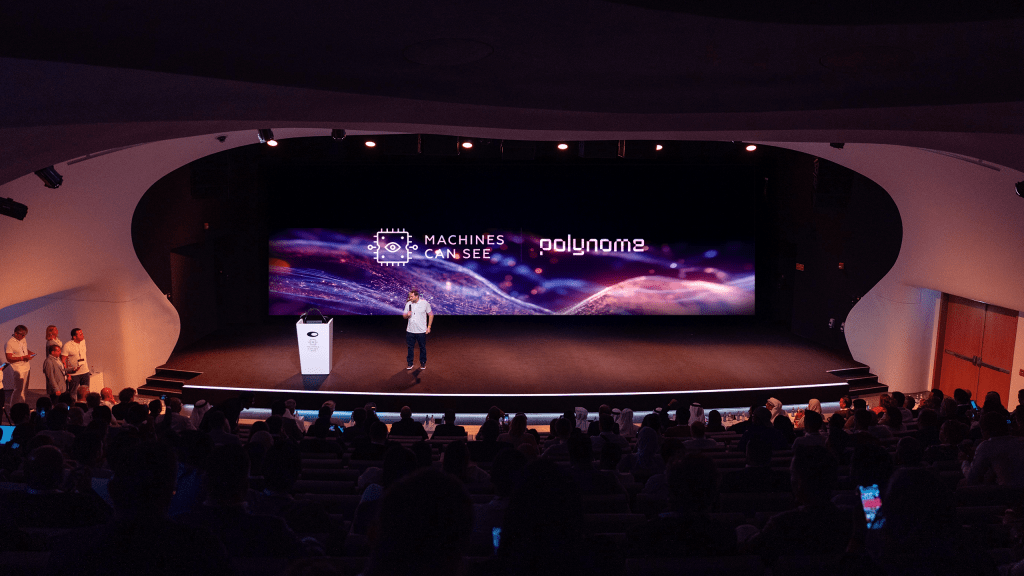
The third edition of the Machines Can See (MCS) Summit wrapped up in style at Dubai’s iconic Museum of the Future, once again showing why the UAE is fast becoming the beating heart of AI innovation across the MENA region.
Hosted by the UAE-based Polynome Group and held under the patronage of H.H. Sheikh Hamdan bin Mohammed bin Rashid Al Maktoum, the Machines Can See summit pulled in more than 3,500 delegates from 45 countries, while online engagement soared to over 4.7 million views with #MCS2025 likely to cross the 5-million mark soon.
Backing the Machines Can See summit were heavyweight partners like Digital Dubai, Dubai Police, Emirates, Amazon Web Services, NVIDIA, IBM, SAP, and MBZUAI.
“In just three years, MCS has evolved from a specialist meet‑up into a true crossroads for the world’s top minds in science, business and public policy,” said Alexander Khanin, founder and CEO of Polynome Group. “The week proved that when researchers, entrepreneurs, and governments share one stage, we move a step closer to transparent, human‑centred AI that delivers real value for society.”
Big Announcements: Startups, Policy, and Education Front and Center
The energy at Machines Can See 2025 wasn’t just about dazzling demos; real deals were made live on stage. Landmark announcements included:
- A trilateral MoU between Astana Hub (Kazakhstan), IT‑Park Uzbekistan, and Al‑Farabi Innovation Hub (UAE), launching a new Central Asia–to–MENA soft-landing platform for startups.
- Google Cloud rolled out a free “Gen-AI Leader” learning track to fast-track AI adoption across the region.
In education, Polynome Group officially launched its new AI Academy, created alongside the Abu Dhabi School of Management and backed by NVIDIA’s Deep Learning Institute. It offers short executive seminars and a four-month Mini-MBA in AI, arming tomorrow’s leaders with hands-on AI expertise.
On the policy side, a high-level ministerial roundtable featuring UAE, Egypt, Malaysia, Kazakhstan, and Indonesia leaders focused on using AI to attract and retain tech talent. They discussed initiatives like national GPU clouds, visa-fast-track programs, and sandbox environments to counter brain drain and spur R&D growth.
Research Breakthroughs and Ethical AI Take Center Stage
Some of the world’s leading researchers unveiled breakthroughs destined to impact daily life:
- Prof. Michael Bronstein (University of Oxford/Google DeepMind) showcased how Geometric Deep Learning is slashing drug discovery timelines.
- Marco Tempest (NASA JPL) merged GPT‑4o dialogue with holographic tech, creating interactive mixed-reality experiences.
- Prof. Michal Irani (Weizmann Institute) revealed AI that reconstructs scenes from just a glance.
- Andrea Vedaldi (Oxford) premiered real-time 3D digital twin generation for city planning, while Marc Pollefeys (ETH Zurich/Microsoft) showed ultra-low latency spatial mapping tech — key for safe robotics and AR services.
Industry players like AWS and NVIDIA held technical workshops, including hands-on Gen-AI clinics and secure deployment best practices. Dubai Police also led closed sessions on predictive policing, emphasizing secure and ethical AI deployment.
On the ethics front, panels such as “Good AI: Between Hype and Mediocrity” and “Defending Intelligence: Navigating Adversarial Machine Learning” drove home the importance of continuous security audits, red teaming, and ISO-aligned AI governance, key themes for MENA governments and tech ecosystems alike.
Prof. Marc Pollefeys summed it up best: “We are at a turning point where technologies like spatial AI and real-time 3D mapping are moving from laboratories into everyday life, transforming cities, workplaces, and how we interact with the digital world.
“The Machines Can See Summit underscores how collaboration between researchers, industry, and policymakers accelerates this transition, bringing innovative solutions closer to everyone.”
Key Takeaways from Machines Can See
As Dubai wraps another game-changing AI summit, three main lessons emerged:
- Talent aviation via unified tech visas, national AI infrastructure, and sandbox clusters — is critical to fighting brain drain.
- Spatial computing is now primed for mainstream use, unlocking real-world AR and humanoid robotics.
- Secure, explainable AI pipelines will be essential for the mass adoption of generative AI across heavily regulated industries.
With its advanced digital infrastructure, innovation-friendly governance, and serious commitment to talent development, Dubai and the wider MENA region, is setting the global pace for the AI-powered future.