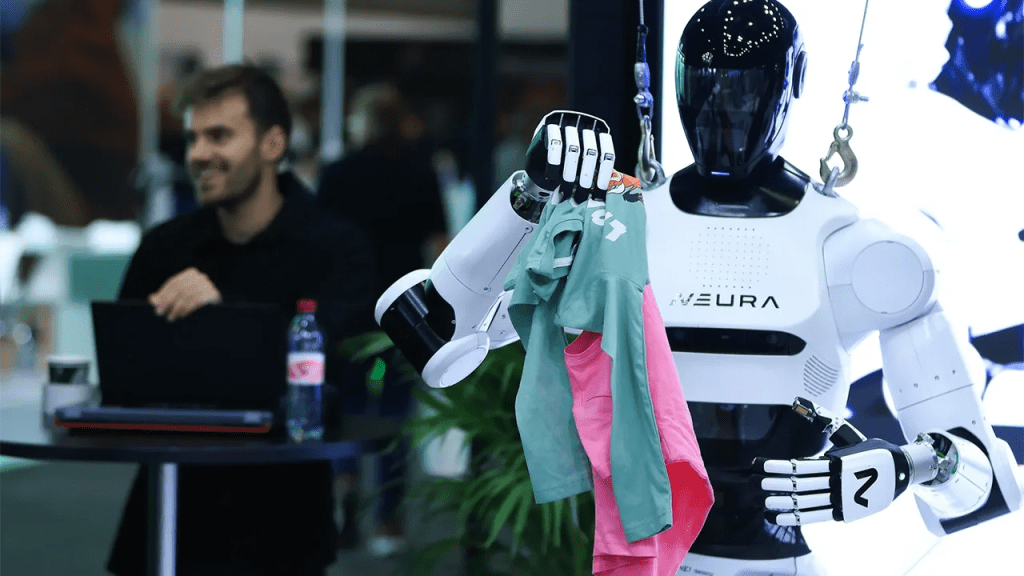
Qatar’s Sheikh Hamad backs Neura Robotics’ $1.2B round, signaling MENA’s growing role in AI robotics and next-gen automation.
Hamad bin Jassim Al Thani has joined a major $1.2 billion funding round for Neura Robotics, underscoring rising global investor interest in AI-powered robotics.
Also Read: OpenAI’s $10B Raise Signals Rising MENA Role in Global AI Race
The round, which also includes Amazon, Qualcomm Ventures, Tether, Robert Bosch GmbH, Schaeffler AG, and Roland Berger, could value the Metzingen-based startup at approximately $4.6 billion.
The fresh capital will support the development and scaling of AI-powered humanoid robots designed for both industrial and household use. Neura Robotics is building bipedal systems capable of lifting heavy objects, sorting items, and automating repetitive workflows, positioning itself in a fast-growing global race to integrate AI into physical labor.
Sheikh Hamad participated through Prime Capital, his Luxembourg-based investment vehicle, which is now managed by his son, Sheikh Mohammed bin Hamad bin Jassim Al Thani. The former prime minister has a long history of high-profile global investments, including stakes in major European firms during his time at the Qatar Investment Authority.
Neura Robotics CEO David Reger revealed the company generated nearly $1 billion in orders last year, with clients including Kawasaki Heavy Industries and Omron. Its robots are already being deployed in environments such as automotive manufacturing and logistics, with additional applications emerging in domestic automation.
The company is part of a broader wave of robotics innovation, competing with players like Figure AI, Dexterity, and Apptronik. Analysts project that AI-powered robotics could evolve into a trillion-dollar market by 2035, driven by demand across manufacturing, logistics, and consumer sectors.
Meanwhile, global competition is intensifying. Chinese firms, including Unitree Robotics, are accelerating development with increasingly advanced humanoid capabilities.
Why Neura Robotics Matters to MENA
This deal highlights the MENA region’s growing role as a capital powerhouse in frontier technologies, such as AI and robotics.
Strategic investments from regional players are no longer limited to traditional sectors; they are increasingly targeting next-generation industries that will define global productivity. For the MENA region, this creates pathways for technology transfer, partnerships, and long-term positioning in the automation economy.