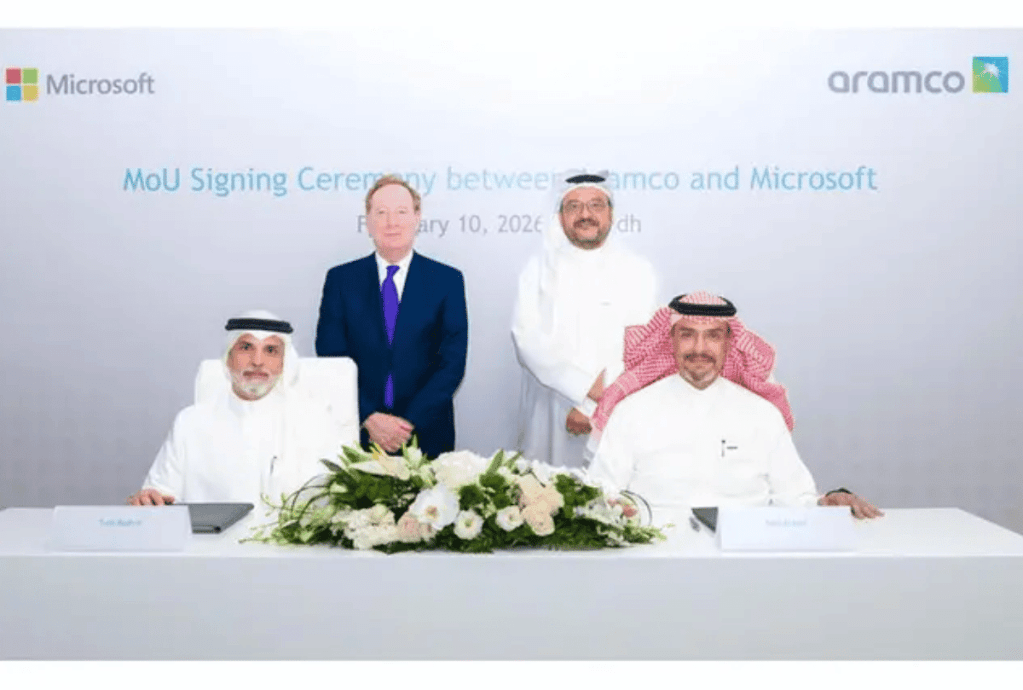
Aramco and Microsoft signed an MoU to scale industrial AI, strengthen digital sovereignty, and advance cloud infrastructure and workforce skills in Saudi Arabia.
Aramco, one of the world’s leading integrated energy and chemicals companies, has signed a non-binding Memorandum of Understanding (MoU) with Microsoft to explore a new wave of digital initiatives aimed at accelerating industrial artificial intelligence (AI) adoption, enhancing digital capabilities, and strengthening workforce development in Saudi Arabia.
Also Read: Batelco and GCCIA Renew Gulf Connectivity Pact
The agreement builds on a long-standing collaboration between the two organizations and supports Aramco’s broader digital transformation ambitions under Saudi Arabia’s Vision 2030.
As part of the MoU, Aramco plans to explore AI-driven industrial solutions built on Microsoft Azure to enhance operational efficiency, strengthen global competitiveness, and pioneer new models for technology-enabled energy and industrial systems.
The collaboration will focus on moving industrial AI from pilot programs into core operations — embedding intelligent systems at scale while maintaining robust governance and security standards.
“Aramco is driving the energy sector’s digital transformation by creating a secure, intelligent, and collaborative digital ecosystem. In partnership with Microsoft, we seek to further scale cutting-edge digital and AI solutions in the sector to achieve efficiency and innovation — without compromising the highest standards of security and governance,” said Ahmad O. Al Khowaiter, Executive Vice President of Technology & Innovation at Aramco.
Brad Smith, Vice Chair and President of Microsoft, described the agreement as a pivotal step in industrial AI evolution.
“This marks the next step in our long-standing collaboration with Aramco, exploring how industrial AI can move from pilots into core operations to improve efficiency and resilience at scale. Our focus is on building strong foundations — sovereign-ready digital infrastructure, trusted governance, and the skills needed for responsible industrial AI adoption,” he said.
He added that Aramco has the opportunity to set a global benchmark for large-scale, responsible industrial AI transformation aligned with Vision 2030.
Key Areas of Collaboration
1. Digital Sovereignty and Data Residency: The companies will explore a roadmap for deploying solutions on Microsoft’s cloud infrastructure enhanced with sovereign controls. The initiative aims to advance Aramco’s digital sovereignty objectives, including compliance with national data residency requirements.
2. Operational Efficiency and Digital Infrastructure: Discussions will focus on optimizing digital frameworks that support Aramco’s global operations and building a seamless, resilient digital backbone to enhance productivity and performance.
3. Industry Alliance Framework: The partnership may expand to include Saudi technology integrators and industry collaborators to accelerate AI adoption across the Kingdom’s industrial value chain.
4. Industrial AI IP Co-Innovation: Aramco and Microsoft will explore co-developing and commercializing advanced industrial AI solutions, potentially establishing a global marketplace for energy-sector AI systems that elevate Saudi-developed intellectual property on the world stage.
Beyond infrastructure and AI deployment, the collaboration will prioritize talent development. The two organizations are exploring programs to accelerate digital and technical skill-building across the Kingdom, focusing on AI engineering, cybersecurity, data governance, and product management.
These initiatives will include measurable outcomes and build on Microsoft’s ongoing national impact programs, which have already trained thousands of Saudi learners in cloud, AI, and data technologies.