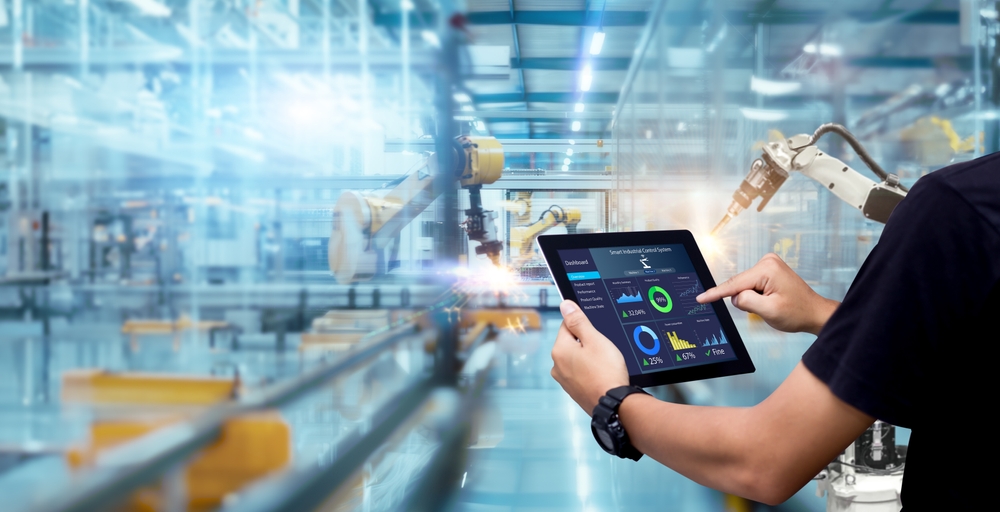
IoT and AI are redefining modern manufacturing, making agility, precision, and efficiency non-negotiable for companies that want to stay competitive. Businesses now face constant pressure to deliver faster, cut down on waste, and adapt to shifting customer demands while still maintaining top quality.
This shift has brought in a new era of manufacturing that combines advanced connectivity with intelligent decision-making to transform operations from start to finish.
Across the Middle East and North Africa (MENA), this transformation is moving quickly. The World Economic Forum notes that around 80% of companies in the region are already adopting digital technologies, and investment in digital transformation is projected to climb from $38.4 billion in 2022 to nearly \$300 billion by 2032.
How IoT and AI are reshaping factories
The latest advancements in smart manufacturing solutions for Industry 4.0 enable the integration of connected equipment, predictive analytics, and autonomous systems into production workflows.
By deploying Internet of Things (IoT) devices and employing Artificial Intelligence (AI), organizations can incorporate real-time insights into their processes. This integration enables them to unlock higher productivity, achieve greater operational visibility, and realize measurable efficiency gains.
In practice, IoT links machines, systems, and people, while AI turns vast data into actionable insights. This connected ecosystem improves production line efficiency, boosts supply chain visibility, detects anomalies, predicts equipment failures, and adjusts schedules to maximize output and reduce downtime.
A study published on arXiv shows that integrating IoT systems for energy and resource optimization can result in 18% reduction in energy consumption, a 22% drop in machine downtime, and a 15% improvement in resource utilization.
Opportunities and Challenges in MENA
While momentum is building, adoption is uneven. Research in Saudi Arabia’s automotive industry reveals that 57% of large firms are aware of localized Industry 4.0 models, yet only 11% have fully implemented them.
This suggests a gap between ambition and execution, particularly for small and medium-sized enterprises that may face resource or expertise constraints.
Even so, GCC manufacturers are leaning heavily into Industry 4.0 to gain a competitive edge. Statista highlights that sectors like industrial machinery are increasingly investing in IoT sensors, analytics, and automation to reduce downtime and enhance sustainability.
These shifts align closely with national agendas such as Saudi Arabia’s Vision 2030 and the UAE’s push to strengthen industrial resilience and self-sufficiency.
Why It Matters
The adoption of IoT and AI in smart manufacturing is not just about boosting productivity, it’s about reshaping the future of the region’s industrial economy.
With sovereign-backed funds and government strategies pouring billions into advanced manufacturing, MENA has the opportunity to leapfrog into a new phase of industrial competitiveness.
For businesses, this means that investing in IoT and AI today could define whether they thrive or struggle in tomorrow’s increasingly digital, efficiency-driven marketplace.